The moment you notice damage, the clock starts
It usually starts small: a damp spot that wasn’t there yesterday, a shingle in the yard, a faint drip after a hard storm. The first reaction is to wait—maybe it dries out, maybe the contractor can “take a quick look” next week. But timing is already becoming a cost. Water keeps moving, mold risk rises, and temporary fixes (tarps, fans, dehumidifiers) start landing on a card before anyone has agreed on “claim” versus “cash.”
At the same time, the paperwork clock is quietly running too. Photos get harder to trust once cleanup begins, receipts disappear, and “when did you first notice this?” turns into a fuzzy answer. Even if the final decision isn’t made today, a clean timeline—date noticed, weather event, first mitigation steps—keeps options open while the damage is still easy to prove.
Your first instinct: “Insurance will cover this”
The next move almost writes itself: call the carrier, start a claim, let the policy do its job. When the drywall is wet and a roofer is booked out two weeks, “I pay premiums for this” feels like the cleanest path. And sometimes it is—especially when there’s obvious, sudden damage and the repair number is clearly beyond what you can float on a card.
But the first phone call is where people get surprised. The questions come fast: exact date noticed, what caused it, what you did to stop it, whether it’s happened before. In some companies, even a “just asking” conversation can turn into a record of a loss event, and now timing matters because an adjuster visit and contractor availability don’t line up neatly. It still may be worth it, but the assumption that coverage equals a check needs testing.
Reality check: deductible, limits, and exclusions bite
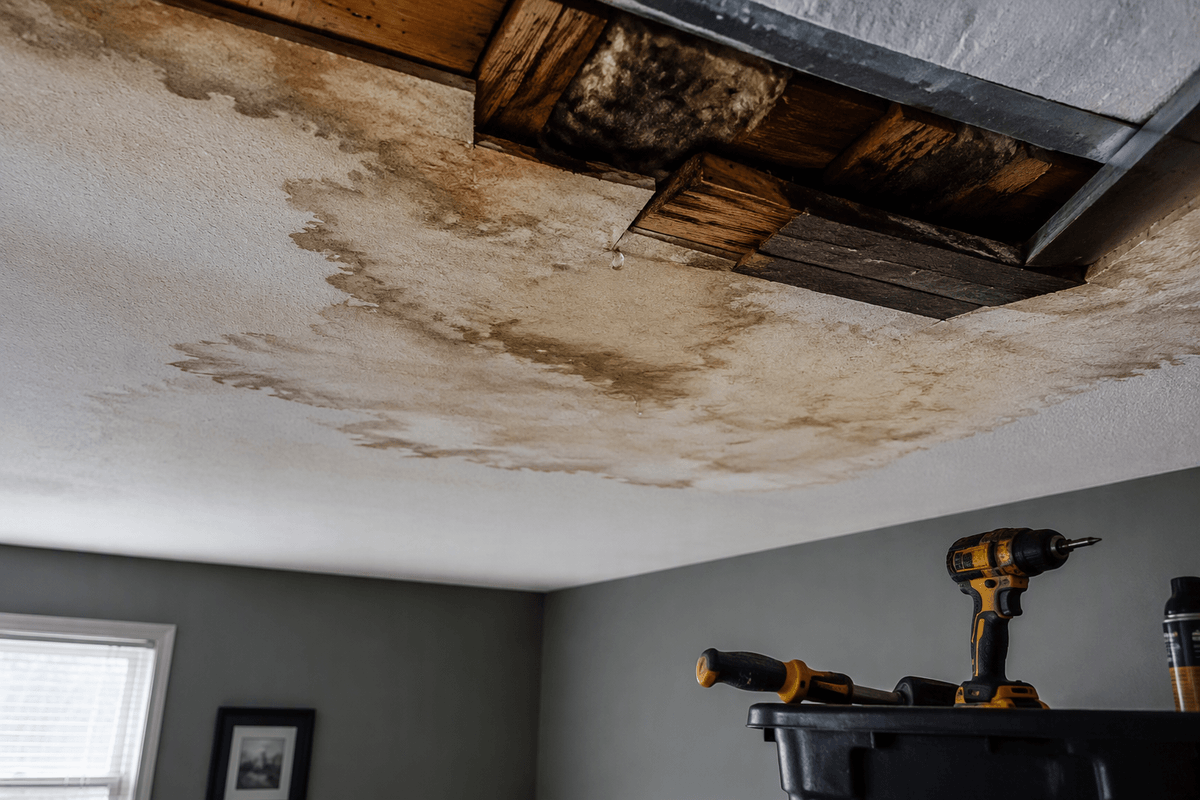
Once the policy language is in front of you, the “they’ll take care of it” feeling usually narrows into three numbers: your deductible, the coverage limit for that bucket of damage, and the part that isn’t covered at all. A $2,500 deductible on a $4,200 repair estimate doesn’t feel like help—especially if the adjuster splits the loss into “roof” versus “interior” and applies sub-limits or separate deductibles you didn’t realize were in play.
Exclusions are where the story can flip. Slow leaks, repeated seepage, worn-out flashing, old shingles, or “maintenance” issues often land in the gray zone where you still have a hole in the ceiling but not a payable claim. Even when the cause is covered, the policy can cap certain items (mold remediation, matching materials, ordinance or code upgrades). That’s how a contractor’s scope turns into a smaller settlement, leaving you paying most of it anyway—plus the permanent mark of a filed claim.
Get a repair number before you decide anything
After you’ve seen the deductible, the decision can still feel binary—file or don’t. But until there’s a real scope with real prices, you’re guessing with the expensive kind of confidence. Contractors can be booked out, and the first available option is often an emergency service crew charging a premium for drying equipment, weekend labor, and “mobilization.” That early money matters because it can swallow the part of the loss you expected insurance to absorb.
Push for at least one written estimate that separates mitigation from rebuild and breaks costs into line items (demo, framing, drywall, paint, roofing, electrical). The split matters: some policies treat mitigation differently, and adjusters often approve pieces, not vibes. Also ask what’s driving the number—material availability, matching requirements, code upgrades, or access issues—because those are the items most likely to inflate after work starts. With a repair range in hand, you can compare it to your deductible and the likely settlement, instead of anchoring to the hope that “coverage” means “paid.”
What you might actually receive after depreciation
With an estimate in hand, the next surprise is that the first check often isn’t written for the estimate—it’s written for “actual cash value” (ACV). If the policy is replacement cost, the carrier may still start by subtracting depreciation based on age and condition, then subtract your deductible. A $12,000 interior rebuild with $3,000 of depreciation and a $2,500 deductible can arrive as a $6,500 initial payment, even though the work still costs $12,000.
The rest is typically “recoverable depreciation,” and it’s not automatic. It usually requires proof you completed the work (paid invoices, photos, sometimes a final inspection), and it can be time-limited—meaning cash flow becomes the constraint, not coverage. Roof claims can be harsher if the policy uses actual cash value for roofs or a percentage wind/hail deductible; the math can turn a big-looking loss into a small net check right when contractors want deposits.
The hidden price: premiums, surcharges, and nonrenewal
After the first check math settles, the decision stops being about this repair and starts being about the next renewal packet. A paid claim can trigger a surcharge at renewal, or simply move you into a higher tier, and the timing is awkward: the increase shows up months later, when the damage feels “done.” If the payout net of deductible and depreciation was only a few thousand, even a moderate premium bump spread over three to five years can erase the win. The constraint is that you usually can’t price that bump precisely from the claim documents you already have.
The other cost is harder to model: availability. Multiple claims close together, or one loss the carrier flags as higher severity, can raise the risk of nonrenewal or force you into a more expensive market at the exact moment your mortgage company still requires coverage. Before you commit, ask the agent (in writing) how a claim like this is typically treated in underwriting, and whether an inquiry-only call becomes part of your loss history with that company.
If you don’t claim, what’s the cleanest fallback?

Sometimes the math points away from a claim, but the house still needs to get put back together on a schedule that doesn’t care about renewals. The cleanest fallback is treating it like a small project with insurance-grade documentation: a written scope, photos before and after, and invoices that separate mitigation from rebuild. That way, if the damage grows or a contractor finds hidden rot, you can prove what was known when you chose to self-fund, instead of recreating the story later under pressure.
From there, keep the funding plan boring and traceable. If you have equity, a HELOC can be cheaper than carrying a balance on cards, but timing is the constraint—draws and appraisals don’t move like emergency drying. If cash is available, pay for the stop-the-bleed work first, then lock pricing with a signed estimate and a change-order process so “out-of-pocket” doesn’t quietly become open-ended.
A safer way to decide: questions, records, and timing
By the time the estimate and the policy math are on the table, the safer move is to slow the decision down just enough to make it auditable. Write down three numbers: the repair range, the deductible, and the likely first-check basis (ACV vs replacement cost). Then ask, before you authorize an adjuster visit, what gets recorded as a claim, what documents they’ll need to pay recoverable depreciation, and whether mitigation invoices are handled differently from rebuild.
Timing is the last lever. If renewal is close, the same claim can land in a different underwriting window than one filed a month later. Keep a dated photo log, weather notes, and every invoice in one folder, and set a personal trigger: “If the scope grows past $X over deductible, I file.” It’s not perfect—just controlled.