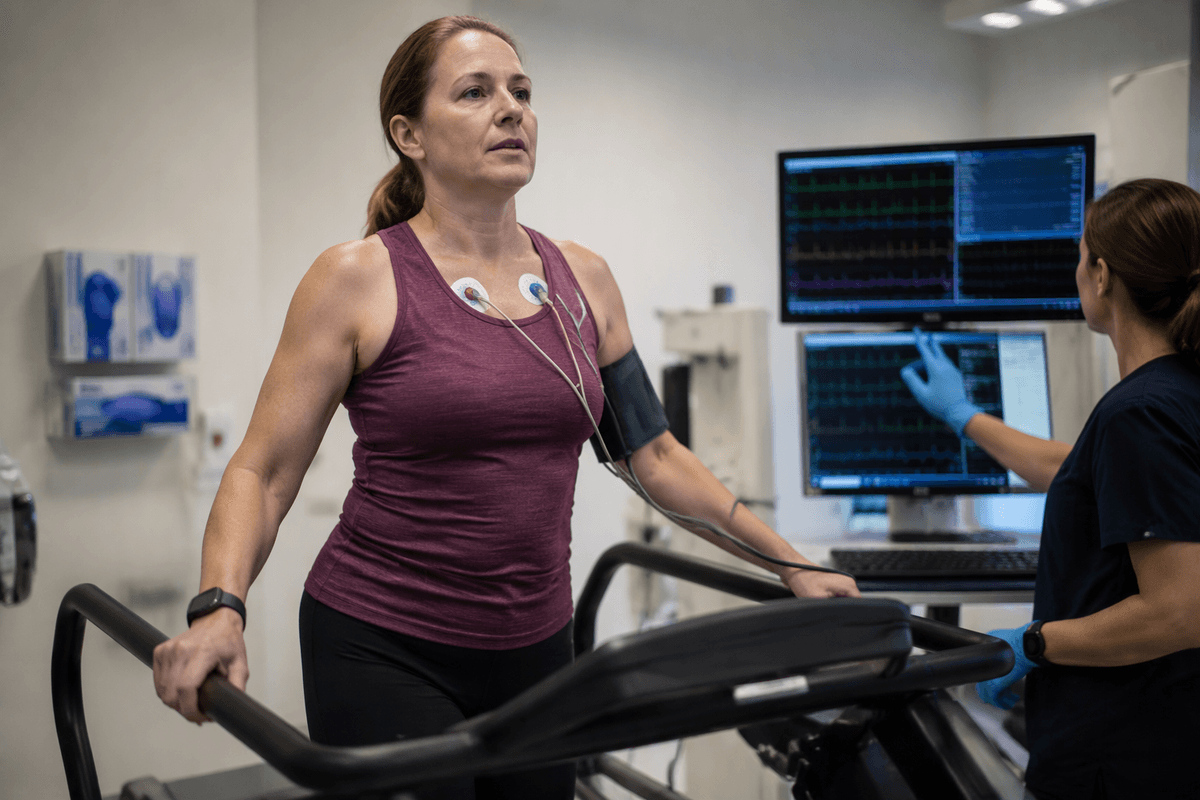
What smartwatches measure versus what your heart does
You glance at your wrist and see a number that feels too high for what you’re doing—standing at the sink, walking to the car, lying in bed. It’s easy to read that value as “what my heart is doing,” but your watch is really reporting what it can detect at the skin, then translating it into a heart-rate estimate. Most of the time, that translation is close enough to feel personal. But it’s still an interpretation, not a direct window into your heart’s electrical activity.
For day-to-day tracking, many watches rely on light-based sensors that look for tiny changes in blood flow with each pulse. That works best when the sensor stays still and has steady contact. Your heart, meanwhile, can speed up, slow down, or beat unevenly for ordinary reasons—sleep shifts, caffeine, dehydration, stress—while the watch may also “change” because the strap moved, your skin got cold, or the signal got noisy. Both can be true at once, and a single spike can reflect either your body, the device, or a mix of both.
Situations where watch readings tend to be reliable
The readings usually feel most “believable” in the boring moments—when you’re sitting, standing, or lying down and your wrist isn’t doing much. In those situations, the sensor can keep a steady view of your pulse instead of chasing it. A snug, comfortable strap (not cutting off circulation, not sliding around) tends to produce fewer sudden jumps, and you’ll often notice the number changes in a way that matches what you can feel: easing down after you sit, nudging up when you climb stairs, settling during sleep.
Another reliability clue is repeatability. If the watch shows a similar resting range at similar times across several days, or your workout warm-up climbs in a familiar pattern, that consistency is hard to fake with random noise. Even then, the data is still an estimate—just one that’s more anchored when contact is stable, movement is minimal, and the “story” of the number fits the moment you’re in.
Why exercise, stress, and cold can confuse sensors
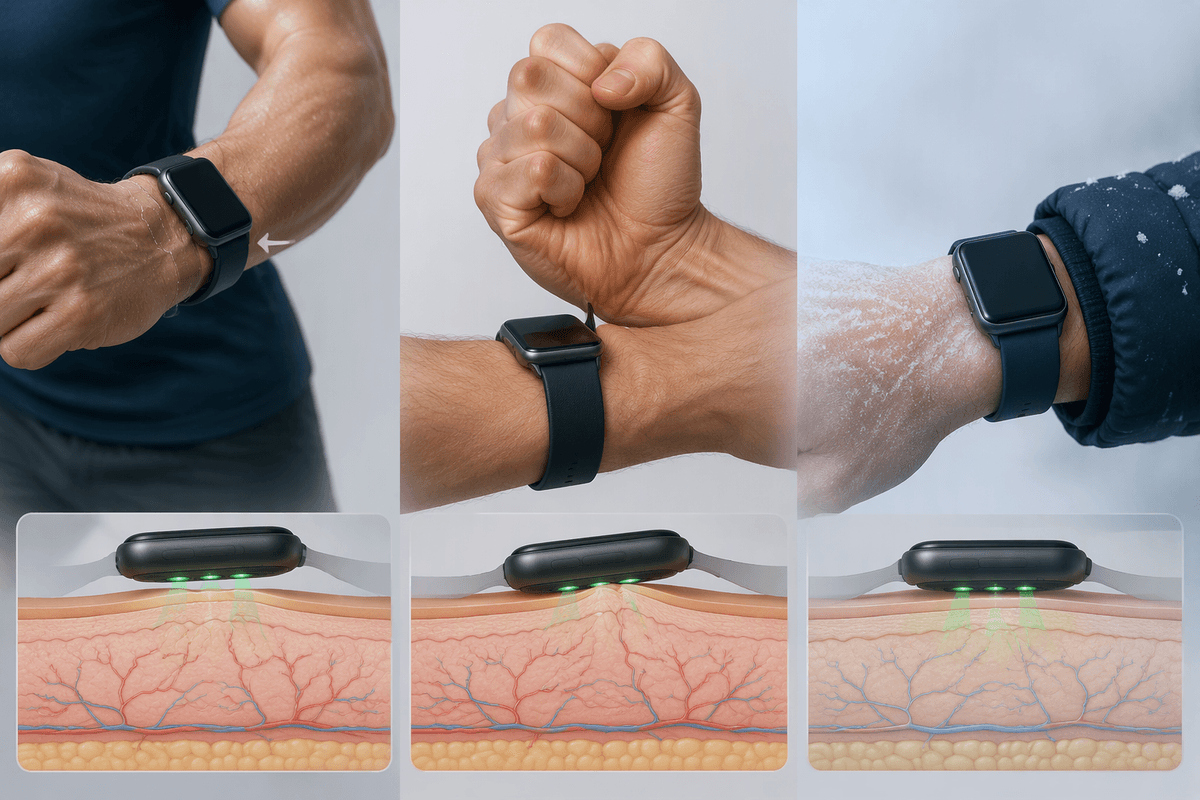
The moment you pick up the pace—grabbing a dumbbell, pumping your arms on a run, even pushing a cart fast—the wrist stops being a quiet platform. The sensor is trying to read tiny pulse-driven changes while your skin shifts, your tendons tighten, and the watch subtly rocks with each movement. That’s when you can get the “impossible” spike: a heart rate that jumps 40 beats in seconds, then drops, even though your breathing and effort barely changed. In some workouts, sweat helps contact; in others, slick moisture plus motion makes the signal smear.
Stress and cold create a different kind of confusion because they change the wrist itself. When you’re tense, you may clench your hand or flex your forearm, which can lift the watch edge just enough to let light leak. Cold, dry air can narrow blood vessels near the skin, so the pulse signal gets fainter right when you’re checking it most. The result can look like a sudden “low,” a patchy graph, or an irregular alert that doesn’t repeat once you warm up and settle.
How alerts can help and still mislead you
The buzz often lands at the worst time—mid-meeting, halfway through a run, or right as you’re drifting off—and your brain fills in the blanks before you even look. In that moment, alerts can be genuinely useful: they notice outliers you might miss, especially if you’re not checking your pulse manually. But the watch isn’t “seeing” your whole cardiovascular picture. It’s flagging a pattern in a limited signal, and that signal can be strained by motion, a shifting strap, cold skin, or a brief loss of contact that gets interpreted as a sudden change.
“High heart rate” or “irregular rhythm” reads like a clear event, yet the same wrist noise that creates a spiky graph can also produce something that resembles irregularity to an algorithm. A helpful check is whether the alert matches the moment: did you feel your heart pounding, feel lightheaded, or was it a quiet, ordinary minute with a messy-looking trace? One alert can be a nudge to pay attention—or just a reminder that the sensor had a bad minute.
Trend watching versus single readings in real life
You’ll sometimes notice the most alarming number is also the shortest-lived: a sharp peak on the graph that you never felt, wedged between two minutes that look normal. That’s the trap of single readings in real life—they’re vivid, screenshot-worthy, and often detached from context. A one-off “180” while you’re tying a shoe can be a wrist moment, not a body moment. But it still sticks in your mind, especially if the alert language felt definitive.
Trends behave differently. A gradual climb during a warm-up, a familiar post-coffee bump, or a resting range that’s been drifting higher all week is harder for random noise to impersonate, because it repeats under similar conditions. Even then, trends can be distorted by quiet changes you forget to count—strap tightness, colder mornings, a new workout, or a firmware update that shifts how the watch smooths data. The useful question becomes less “Was that spike real?” and more “Does the pattern keep showing up when everything else is the same?”
When a reasonable check becomes anxious over-monitoring
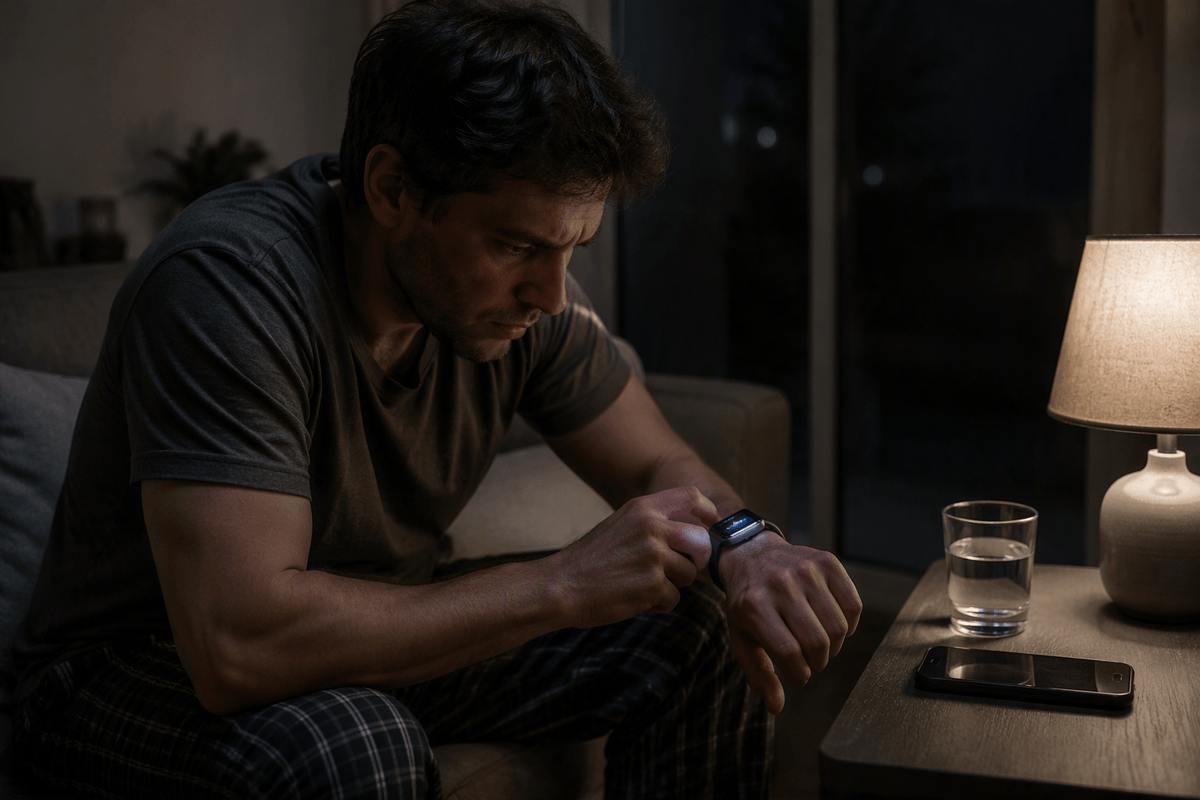
It often starts innocently: you feel a flutter of uncertainty, glance at your wrist, then glance again a minute later “just to confirm.” The number becomes a moving target, and normal shifts—standing up, taking a call, walking upstairs—can read like a developing problem. If you’ve recently had an alert, it’s even easier to treat the watch like a bedside monitor, even though the sensor is still dealing with strap pressure, wrist angle, and the occasional patch of bad contact.
Over-monitoring has a way of feeding itself. The more often you check, the more likely you’ll catch a stray spike, a brief dropout, or an algorithm hiccup that looks meaningful in isolation. Then you compensate—tightening the strap, holding your arm still, re-running a measurement—which can turn a quick self-check into a loop. The worry feels like “being responsible,” even when the data you’re reacting to is the least stable kind: single, context-free moments.
Signals that deserve medical confirmation, not guesswork
Sometimes the clue isn’t the number itself, but how it behaves when you try to recreate the moment. If a high or low reading shows up repeatedly at rest—sitting still, warm, with good strap contact—and especially if it lasts minutes rather than seconds, it’s harder to dismiss as a wrist artifact. The same goes for “irregular rhythm” alerts that keep appearing under calm conditions or during sleep, where motion is low and the sensor usually has its best chance to settle.
What tends to deserve confirmation is a pattern that starts to intrude on real life: episodes that come with chest pressure, faintness, unusual shortness of breath, new weakness, or a feeling that your heart is “skipping” that you can notice without looking. A watch can’t sort out all the possible causes of that mismatch, and it may even look cleaner than it is. At that point, the most useful next step usually isn’t another re-check—it’s letting a clinician match your story to a medical-grade rhythm capture.