Why rectal cancer can stay quiet early
It often starts with something easy to brush off: a faint streak of blood that looks like hemorrhoids, a week of constipation after travel, stools that seem a little thinner when you’ve been stressed and eating differently. Because the rectum can bleed a small amount without causing sharp pain, the body doesn’t always “announce” that anything is wrong. And when you still feel mostly fine—working, driving kids around, keeping up with life—it’s natural to treat these changes as temporary.
The trouble is that some growths begin slowly as polyps and can change over time while symptoms stay mild or inconsistent. A small amount of ongoing bleeding may show up as fatigue you blame on sleep or workload. Bowel habits can swing between loose and hard depending on diet, making the pattern harder to trust. In some situations, months can pass before the shift feels “real enough” to mention—by then, the problem may have had time to move deeper into nearby tissue, which can make next steps more complicated.
How screening finds problems before symptoms do
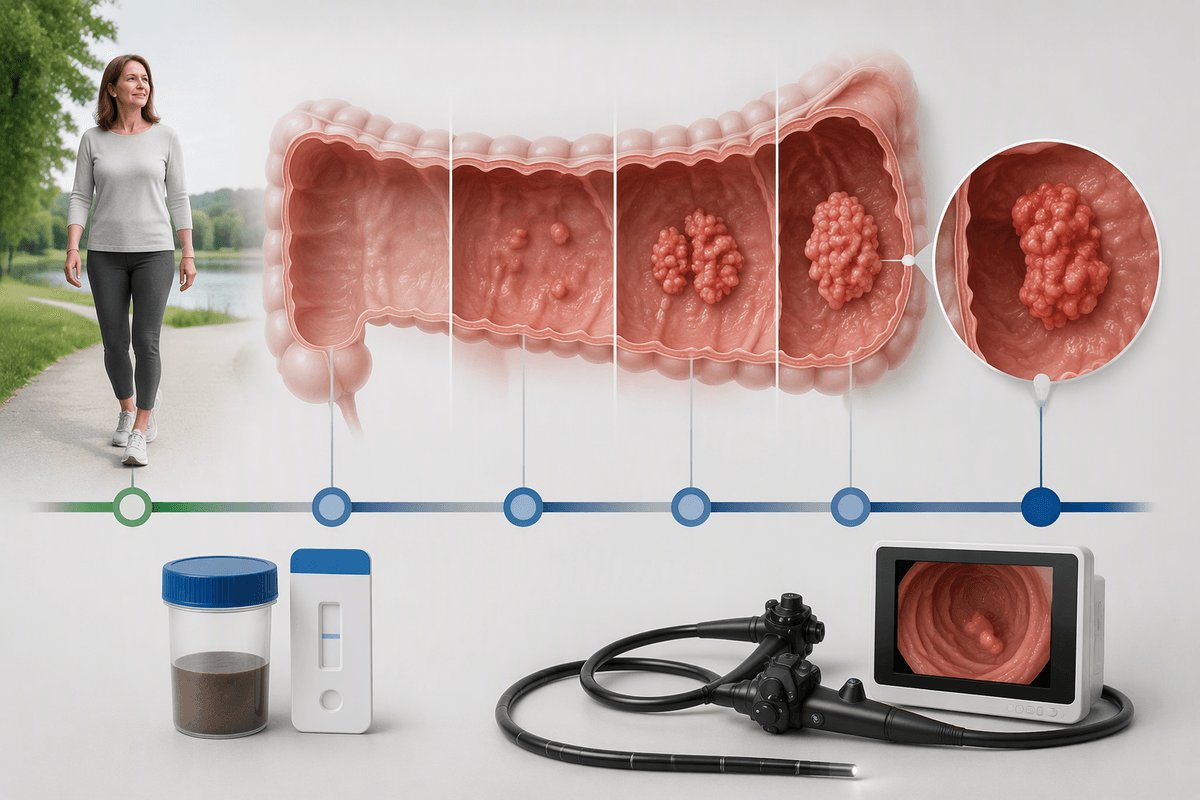
Sometimes the first “signal” isn’t a feeling at all—it’s a lab result you weren’t expecting. You mail in a stool test because you’re trying to be responsible, or you finally schedule a colonoscopy because the reminder kept popping up. Then the report comes back positive or “needs follow-up,” even though the bleeding stopped weeks ago and your energy feels normal again. That mismatch can be unsettling, but it’s also part of how screening works: it isn’t waiting for a steady, obvious symptom to prove something is wrong.
Screening looks for quiet changes that can come and go in daily life—tiny amounts of blood in stool, or polyps that don’t hurt yet but can slowly shift over time. A colonoscopy can find and remove certain polyps before they have a chance to grow deeper. Stool-based tests can’t tell you the cause, so a prompt follow-up exam matters; otherwise it’s easy to assume the “good week” meant the issue passed.
Choosing a screening test when options feel imperfect
The hesitation often shows up in small, practical ways: the bowel-prep instructions sitting unopened on the counter, the worry about taking a day off work, the quiet hope that a stool test will be “good enough” so you can move on. It can feel unfair that you have to choose between options that each come with a downside—especially when you feel mostly fine and the bleeding, if it happens at all, seems sporadic.
Stool-based tests are easier to start, but they can create an awkward limbo: a positive result doesn’t explain whether the blood came from a polyp, a sore spot, or something else, and it can’t remove anything that’s growing. A colonoscopy asks more up front—prep, sedation, arranging a ride—but it’s also the one test that can look directly and sometimes take care of polyps in the same visit. Even “normal” results don’t erase every concern, but delaying follow-up often keeps the question hanging longer than people expect.
What changes when cancer is caught earlier
The difference sometimes shows up in the first phone call: “We think we got it all,” versus “We need more imaging.” When a growth is found before it has worked its way deeper into the rectal wall, the next steps may feel more contained—more like a procedure that fixes a problem than a plan that takes over your calendar. People often describe a strange mix of relief and disbelief, especially if they’d felt fine enough to keep postponing.
When it’s caught earlier, treatment may lean toward simpler moves—removing a polyp or a small, localized spot—rather than layering on radiation, chemotherapy, or bigger surgery to protect nearby tissue and lymph nodes. That doesn’t mean it’s effortless; even “early” care can bring soreness, temporary bowel changes, and anxious waiting for pathology results. But the trade-off many people notice is fewer unknowns at once: less time spent trying to explain months of on-and-off bleeding, and more time focused on a clear, limited next step.
Treatment paths and the trade-offs people notice

The first real trade-off can hit in the most ordinary place: standing in a pharmacy aisle, reading labels for skin barrier creams or anti-nausea meds you never expected to need. Even when a plan is “standard,” it rarely feels simple in day-to-day life. Some people notice that the rectum is less forgiving than they assumed—sitting can feel different, urgency can show up without much warning, and foods that used to be harmless may suddenly feel like a gamble.
Treatment paths can look similar on paper but feel very different in the body. Surgery may offer a clean sense of “it’s out,” yet it can come with temporary (or sometimes longer) changes in bowel control, frequency, or sexual function. Radiation and chemotherapy can be used to shrink or control what can’t be safely handled by surgery alone, but the trade-off is often cumulative fatigue, irritation, and a calendar that keeps filling up. A decent week can make you wonder if you’re overreacting, right before a harder day makes the need for follow-through feel obvious again.
When a reasonable choice creates unexpected confusion
It can feel like you did everything “right,” and still end up confused. You chose the stool test because it fit into a busy week, then the result comes back positive and the bleeding you’d noticed is gone again. Or you finally get the colonoscopy, wake up groggy, and hear a mix of phrases—“we removed a polyp,” “we took biopsies,” “we’ll call you”—that sounds both reassuring and unfinished. That gap between what you feel in your body and what the test suggests is where a lot of second-guessing starts.
In real life, follow-up doesn’t always move as smoothly as people expect. Appointments stack up, pathology takes time, and the details matter: was it a polyp with higher-risk changes, a spot that couldn’t be fully removed, or something that points to deeper layers? When symptoms stay inconsistent—one normal-looking week, then narrow stools or fatigue again—it’s easy to misread the quieter days as proof the concern has passed.
Patterns that shape recovery and long-term follow-up
A few weeks after the rush of appointments, the body can start sending quieter, less predictable signals. One day your bowel movements feel almost normal, and the next day there’s urgency, clustering trips to the bathroom, or a dull tiredness that doesn’t match what you did. That inconsistency is where people often get tripped up. It may feel like the problem is “gone,” then a small streak of blood or a stretch of narrow stools shows up again and pulls you back into doubt—especially if you’re juggling work, travel, and family routines.
Long-term follow-up tends to run on patterns, not single days. Imaging, repeat scopes, and lab checks can feel repetitive, but they’re trying to answer a practical question over time: is healing moving forward, and is anything reappearing quietly? The limitation is that recovery rarely looks linear—diet changes, pelvic irritation, stress, and medications can all mimic warning signs. If a change keeps returning or gradually becomes the new normal, that’s usually the detail worth bringing back to the care team.