You found a unit, and the clock starts
The listing finally looks real: right neighborhood, workable commute, not obviously overpriced. Then the agent replies, “We’re showing today—applications are reviewed in the order received.” That’s the moment the process changes. It stops being about browsing and starts being about not fumbling a deadline. Application fees aren’t refundable, and the unit won’t wait while you hunt for a pay stub or reset a password on an old account. Most first-time renters lose time in small places—printing, scanning, finding a guarantor—right when speed matters most.
Once you’ve identified a unit you’d actually take, assume you’re in a soft race. Landlords often start screening as soon as complete applications land, not after the tour. If you wait until you “feel sure,” someone else pays the fee first and locks up the review slot. The constraint is timing: you may have hours, not days, to produce clean documents.
Decide early what you’re willing to share fast, and what you’ll only provide after you’ve confirmed the unit is legitimate and the terms match your budget. The goal isn’t perfection—it’s getting to “complete enough to review” without tossing full account numbers, extra statements, or unnecessary IDs into an email thread you don’t control.
Build a quick-start packet before you tour
Before you ever step into the showing, put together a “quick-start packet” that’s ready to send the same day. The friction isn’t big—it's five-minute gaps that turn into lost spots: a dead printer, a bank login that needs a text code, a PDF that won’t open on your phone. If the unit is competitive, those gaps cost you more than the application fee.
Keep it lean at first: a single folder with (1) a short cover note with your move-in date and who will live there, (2) photo ID (front only unless asked), (3) one primary income proof, and (4) contact info for one prior landlord or property manager. Save the heavier items—full statements, extra IDs, Social Security docs—until the listing checks out and the terms match what you can actually afford.
Prove you are you without oversharing

When the agent asks for “ID,” it’s easy to overcorrect and send every card in your wallet. Don’t. Start with the minimum that proves you’re a real, reachable person: a clear photo of your driver’s license or passport, plus the exact name and phone number you’ll put on the application. If your current address doesn’t match yet (recent move, out-of-state), add a simple utility bill or insurance card showing your name—only if they ask. The constraint here is speed: you want something they can verify in under a minute.
Control what’s exposed. Send the front of the ID first, and only provide the back if the application specifically requires it. If you’re uploading to a portal, crop the image to the document edges and remove unrelated photos from the frame. If you’re emailing, convert to a PDF and redact what you can (ID number, barcodes) unless the form needs it. The goal is “verifiable,” not “fully indexable,” especially before you’ve confirmed the unit, fees, and lease terms.
Income proof: fastest options, least sensitive first
After ID, most applications bottleneck on income. The request sounds simple—“two pay stubs” or “proof of funds”—but the mistake is sending the biggest, most revealing document first because it’s the easiest to export. Start with what confirms stability without mapping your whole financial life. A recent pay stub works well because it shows employer and year-to-date earnings, and it’s usually a single page you can download in minutes. If you’re salaried and your payroll portal is slow, a signed offer letter with start date and base pay can move you into review while you pull stubs later.
If your income is variable (tips, commission, contract work), lead with a short employer letter verifying average monthly pay or hours, then add a narrow slice of bank history only if asked. When you do use statements, send one month, redact account numbers, and avoid sending every page of transactions. For self-employed renters, a recent 1099 plus a profit-and-loss summary is often faster—and less invasive—than full tax returns. The constraint is privacy: once a document is forwarded, you can’t pull it back, so escalate only as the landlord’s requirements harden.
Credit and background checks: consent and control
Once income is believable, many landlords pivot to “run credit and background.” That’s where people lose control fast, because the request often arrives as a casual text: “Send your SSN and DOB.” Don’t do that over email. Ask what service they use, what reports they pull, and whether the fee is paid inside a portal. The constraint is cost: if you authorize a pull for the wrong unit or a fake listing, you’re out the fee and your data is exposed.
Give consent in one place, one time. Use the screening link from the management company’s official site or a known tenant portal, and keep a screenshot or receipt showing what you authorized. If you’ve frozen your credit, plan the timing: thaw it for a short window, then refreeze. If something comes back “needs review,” ask what they need to clear it—before you resubmit and pay again.
Rental history and references when paperwork is thin
After the credit pull, the next snag is often “rental history.” If you’re new to renting, coming from overseas, or your last place was a roommate situation with your name off the lease, the portal can feel like it’s asking for something that doesn’t exist. Don’t stall—offer what can be verified quickly: the address, dates you lived there, who collected rent, and how it was paid.
Lead with the cleanest reference first: a prior landlord or property manager email on a real domain, or a leasing office phone number that’s publicly listed. If that’s thin, use an employer or supervisor who can confirm reliability and stability, plus 2–3 canceled checks or bank lines showing rent payments (redact account numbers). The constraint is timing: give them verifiable contacts now, and promise heavier proof only if underwriting requires it.
Share documents securely, then watch for limitations
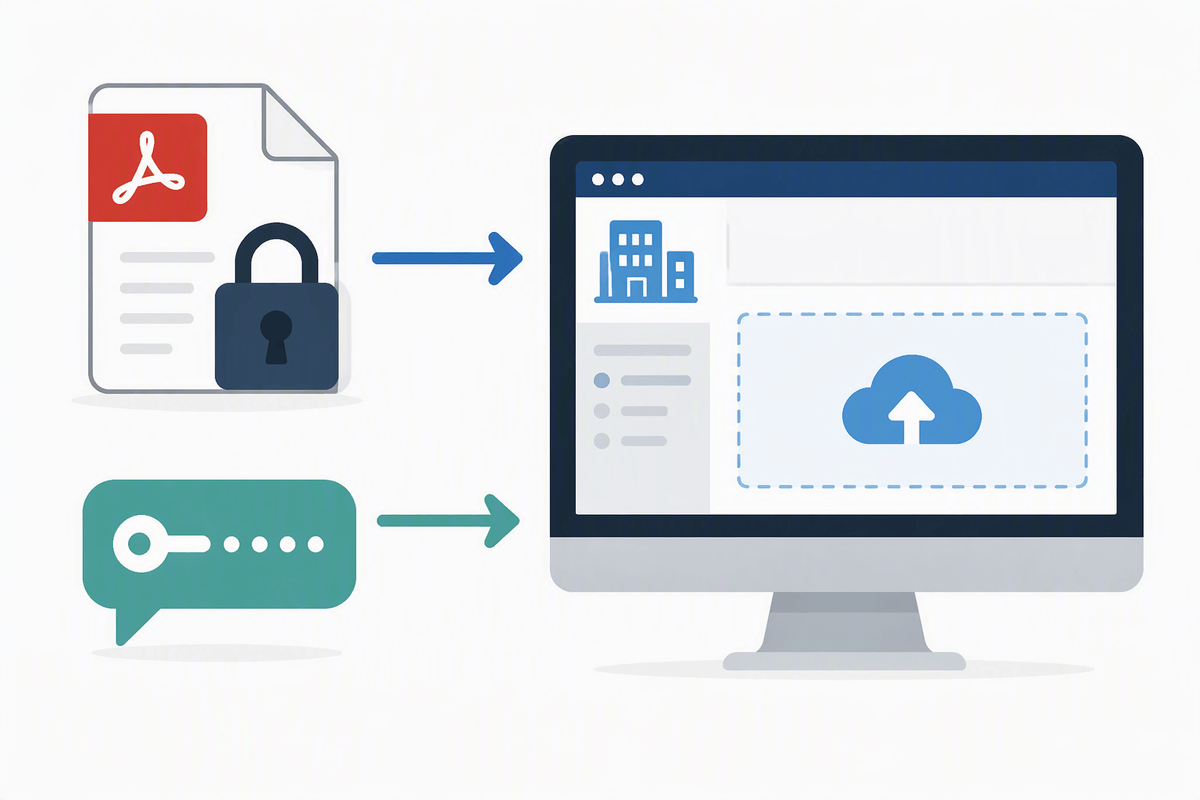
By the time they’re ready for documents, the pressure shifts from “do you have it?” to “how are you sending it?” A surprising number of approvals get delayed because files are blurry, too big for the portal, or stuck in an agent’s personal inbox. Treat the upload like part of the screening: use the property’s application portal when it exists, and if it doesn’t, send a single PDF packet with clear filenames and page order. Password-protect the PDF and share the password in a separate message. That one extra step slows down casual forwarding.
Then watch for the quiet limitations that show up after you’ve sent everything. Some systems reject redacted documents, screenshots, or “exported” bank PDFs, and they won’t tell you until hours later. If they ask for “full statement,” clarify whether they mean all pages or just the summary page plus the deposit lines they need. If they insist on email-only or request SSN/DOB outside a portal, pause and ask for a secure alternative before you keep paying fees and widening exposure.
A one-page checklist to apply in minutes
When you’re down to minutes, decision fatigue is the real enemy. Keep a single “apply-now” page you can glance at, then send the same clean set every time. The constraint is pace: once you’ve paid a fee, you don’t want to discover the portal also needs a second contact, a vehicle plate number, or a W-2 you didn’t pull.
Your one-page checklist: legal name + current address; move-in date and occupants; employer name, supervisor, and HR phone; last 2 pay stubs (or offer letter) as one PDF; photo ID (front); prior landlord/manager contact + dates; three personal references (names + phones) if required; last 4 digits only for SSN until the portal asks; credit freeze plan (thaw window + refreeze); and a “notes” line for pet details, parking needs, and the exact unit number. Keep a saved version with redactions, and a second “escalation” folder only if underwriting pushes back.